You hear about a new app, web page, and product every day. Companies are always in a race to get acknowledged as the best in business. But what distinguishes the winners? Why because a flawless execution can only be possible through testing and its efficiency entirely depends on how well test data is managed.
Tests also identify bugs, performance deficiencies and usability problems. But to test well, teams require high-quality and reliable test data. This is where the Test Data Management (TDM) comes in. It provides test data that is accurate, secure, and production-like without leaking sensitive information.
So, what is TDM exactly, why is it so important and how do companies perform TDM well? Let’s explore.
What is Test Data Management?
Test Data Management (TDM) is the process of creating, managing, and organizing non-production datasets for software testing. These datasets mimic real-world scenarios while maintaining user privacy and data protection.
The goal of TDM is to provide realistic datasets that allow teams to test applications in conditions similar to live environments without risking exposure of personally identifiable information (PII).
Different organizations apply TDM in different ways depending on their testing needs. But the core objective remains the same: supporting accurate, efficient, and secure software testing.
Why is Test Data Management Important in 2025?
Here are the key reasons why businesses prioritize TDM today:
1. Ensures Relevant and Accurate Data
Testing with outdated or incorrect data is like studying from the wrong textbooks; you’ll never pass the exam. Similarly, using irrelevant datasets in testing leads to inaccurate results. TDM ensures that test data is current, relevant, and aligned with testing objectives.
2. Compliance with Data Privacy Regulations
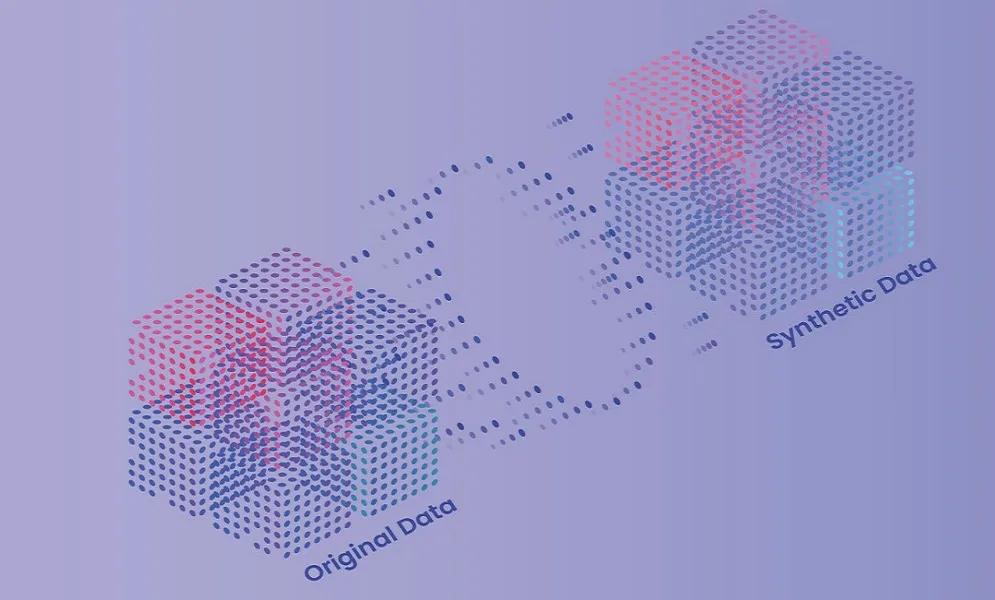
With strict privacy laws such as GDPR, HIPAA, and CCPA, mishandling sensitive data can lead to hefty fines. TDM uses data masking, synthetic data generation, and compliance monitoring to prevent accidental data leaks and keep businesses safe from lawsuits.
3. Reduces Data Complexity
Managing multiple, unorganized copies of data creates inefficiency. TDM minimizes clutter by providing streamlined, well-structured datasets, ensuring testers only work with what’s truly needed.
4. Faster Product Launches
Manual data collection can take days or weeks. TDM leverages automation and synthetic data generation to cut testing time dramatically. This accelerates development cycles and ensures products reach the market faster.
Test Data Management Process Phases
To implement TDM effectively, businesses follow five crucial phases:
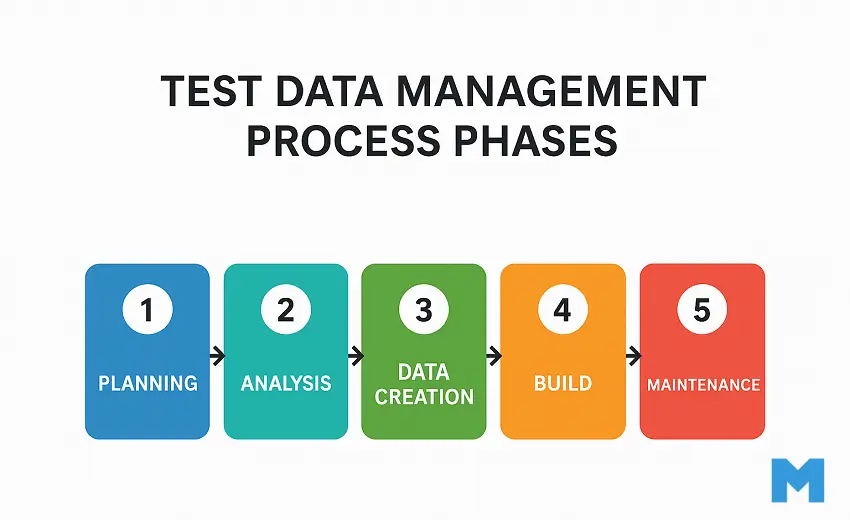
- Planning: Identify test cases and define the data required (e.g., usernames for login tests).
- Analysis: Examine data type, format, volume, security measures, and access permissions.
- Data Creation: Decide whether to clone production data or generate synthetic datasets.
- Build: Implement chosen strategies, apply masking techniques, and set up secure environments.
- Maintenance: Update and manage test data regularly to ensure accuracy and compliance.
Best Practices for Test Data Management
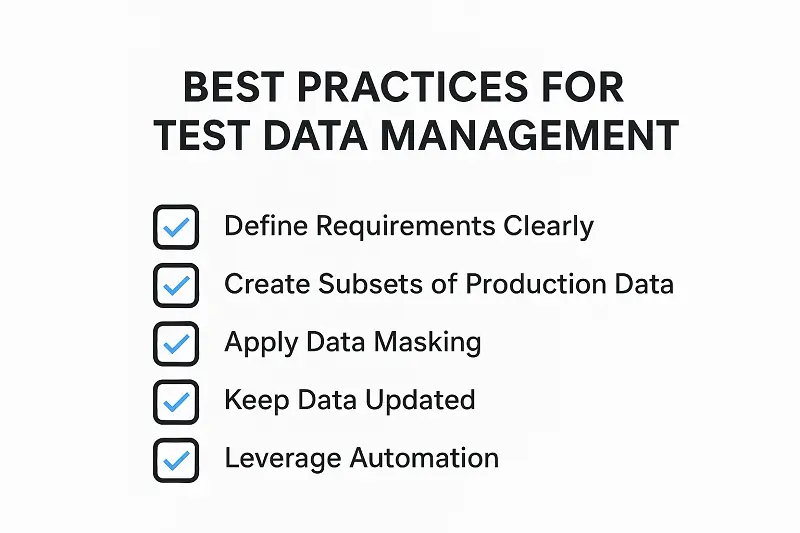
Here are proven strategies for making TDM more effective:
- Define Requirements Clearly
Avoid creating unnecessary datasets. Focus only on the information needed for test cases. - Create Subsets of Production Data
Use smaller, relevant slices of data to reduce complexity while retaining critical details. - Apply Data Masking
Mask sensitive customer or client data before transferring it to test environments. - Keep Data Updated
Outdated test data produces unreliable results. Refresh datasets regularly to reflect real-world changes. Leverage Automation
Use automated tools to compare test results against baselines, saving time and reducing errors.
Top 5 Test Data Management Tools in 2025
Here are five leading tools businesses can use for effective TDM:
| Tool | Key Feature | Best For |
|---|---|---|
| GenRocket | 660+ data generator | On-demand synthetic data |
| K2View | Handles 5B+ queries daily | Enterprise-scale environments |
| Datprof | Centralized management | Multi-environment test data |
| Informatica | Automated data discovery | Salesforce users |
| InfoSphere Optim | Strong compliance focus | Privacy-driven industries |
Frequently Asked Questions (FAQs) on Test Data Management
What is the main purpose of Test Data Management (TDM)?
How does TDM help with data privacy compliance?
What is synthetic test data?
Can TDM reduce software development time?
What industries benefit the most from TDM?
What are the challenges of Test Data Management?
Managing large volumes of data efficiently
Ensuring compliance with evolving privacy regulations
Balancing cost and resource allocation
Keeping test data consistently updated
Which tools are best for Test Data Management in 2025?
Is TDM suitable for small businesses?
Conclusion
Test data management is no longer optional; it’s a necessity for businesses aiming to release secure, high-performing, and reliable applications. By ensuring data accuracy, protecting privacy, reducing complexity, and speeding up development, TDM directly impacts product quality and time-to-market.
To maximize success, organizations should follow the five phases of TDM, adopt best practices, and choose the right tools for their needs. In 2025 and beyond, effective TDM will remain one of the most important strategies for delivering software that users can trust.